A DMV trip led me down a rabbit hole into the SAVE Act—here’s what I found
It’s not just about noncitizens. Here’s who else gets caught up in this.
Tuning In
Recently, a personal experience got me thinking about the debate surrounding the SAVE Act, the voting bill President Trump pushes at every opportunity and is currently sitting in congressional limbo.
I needed to renew my driver’s license and for the first time apply for the REAL ID version. When last I renewed, the REAL ID program had just begun in my state and frankly I hadn’t been paying attention to it, so when I showed up to the DMV eight years ago I was caught unaware by the question from the clerk about whether or not I wanted a REAL ID.
As my renewal date approached this time I was better prepared, or so I thought.
Fancy Seals and Middle Names
I knew from general discussion that a passport or birth certificate was needed to obtain a REAL ID. My passport had expired but I had my birth certificate, which appeared to be an official copy with an ink-stamped seal from the state of my birth.
I wasn’t sure what else was needed so I got online and found a list of required documents; as I scrolled my eye landed on a section about birth certificates, the one thing I already had covered.
Turns out, I didn’t. “Must be government-issued with a raised seal. Hospital birth certificates don't work.” Mine had an official stamp with information and signatures from the state of issue, but it was an ink stamp, not a raised seal on what looked like a microfilm copy.
Not wanting to risk it I immediately ordered an “official” copy. That raised seal ended up costing me $63. I could have gotten it for less without the Next Day Air shipping but at that point I was in a time crunch.
I then riffled through the omnipresent stack of mail that I will always get to tomorrow and found a few items that would work as proof of my address. I shoved them in a manila envelope and crossed my fingers the birth certificate would arrive in time; it arrived two days later. Turns out my state of birth is one of the efficient ones when it comes to fulfilling birth certificate orders, some can take as long as four months.
I decided to look over the instructions one more time just to be sure I had everything, and that’s when I noticed the “Tips” section at the bottom of the web page.
“Make sure names match exactly across all documents. A missing middle name or different spelling can cause rejection.”
Most of my bills and statements are addressed with first and last name only, a few have my middle initial, a few more add in my suffix. I can’t remember anything being addressed to my full name.
As I’m frantically pondering this I stumble across a statement from a bank account I forgot I had. It was set up years ago to deal with a long finished project and I kept it around with a minimal balance for who knows why, but thankfully I had because it was addressed with my entire name, suffix and all.
Friction as Suppression
Maybe I didn’t need the expensive birth certificate or my full name on a document, but interpreting legalese isn’t my area of expertise so I was left with enough uncertainty I did what I thought was necessary.
Point is, even when you think you have all that you need, things can go from black and white to gray fast, leaving you at the mercy of a clerk interpreting vague bureaucratic language. I was lucky that I started the process with enough time (barely), that the state I was ordering from processes quickly, and that money wasn’t an issue for me. Many people in my shoes wouldn’t be so lucky.
The real kick in the pants is my new REAL ID doesn’t count as a way to prove citizenship under the SAVE Act since I don’t live in one of the five states that issue proof of citizenship enhanced REAL IDs.
In the end, your ability to “prove” your citizenship might not be as quick and simple (or as cheap) as you think.
Strong Signal
Tuning in the strong stories with weak reception.
This week’s featured Strong Signal is the first installment in a three part series on the SAVE Act.
What is Required
There is no better place to start for a series on the state of elections in the United States than the federal bill that President Trump not only pushes at every public opportunity, but also used a primetime address to the nation to argue for its passage. The Safeguard American Voter Eligibility Act (also called the SAVE Act or SAVE America Act) [SB 1383], is presented as a way to keep noncitizens from voting in U.S. elections—something never proven to happen in meaningful numbers1.
My distrust of any proposed legislation is proportional to how hyperbolic the name of the proposed act is. That said, it’s what’s on the inside that really matters (just like mama said).
Proving Citizenship
If you have a problem, maybe you find a large spider in your bedroom, how do you solve that problem? Squish the spider with a shoe, or burn down your house? If a dead spider is all you judge the outcome by, either choice will give you success, but one lets you keep your house. The how is everything. How this bill solves a problem that has never been proven to exist is the key to understanding what is actually happening. We’ll start with how you prove citizenship2.
Accepted Documents that Prove Citizenship by themselves:
- U.S. Passport
- REAL ID driver’s license from one of the five states that indicates citizenship
- Government-issued photo ID that shows a U.S. birthplace
Accepted Documents that Pair together to Prove Citizenship:
- Birth Certificate + driver’s license or other government-issued photo ID
- Military ID and service record that says the person was born in the U.S.
“If presenting a government-issued photo ID that doesn’t say the person was born in the U.S. or has citizenship, a registrant would also need either the certified birth certificate or a hospital birth record, adoption decree, a consular birth report, a naturalization certificate, or an American Indian card with the classification “KIC,” which designates U.S. citizenship for Mexican-born members of the Kickapoo tribes of Texas and Oklahoma.”
— FactCheck.org
Based on my recent experience applying for a REAL ID I want to highlight that not all birth certificates are equal. FactCheck.org explains it like this:
The legislation lists requirements the birth certificate must meet, such as including the full names of at least one parent, the signature of an authorized government official, and the seal of the state or local/tribal government that issued it.
If like me you think you have your birth certificate you better make sure it meets the requirements, especially if your birth state isn’t as efficient as mine.
Passport to a Poll Tax
The gold standard option on the list of approved documents is the U.S. Passport. If you’re lucky enough to have one, you’ve got nothing to worry about. The problem is, most Americans don’t have one. In fact, the number of citizens without a passport is nearly as large as the entire population that voted in the last presidential election:
Approximately 146 million American citizens do not possess a valid passport—for context, 153 million Americans voted in the 2024 presidential general election
— Center for American Progress
There are two types of passports: a passport card and a passport book. The base application fee for the passport card is $65. The bill doesn't specify passport book vs. card, but under federal law both count as valid U.S. passports, so I am making an assumption here that the card version will be acceptable. If it’s not then you will need the $165 passport book. If you need either quickly that will be an extra $60. In addition to those costs you will still need to provide a valid birth certificate, which as you recall cost me $63.
If you use my experience as an example and remove the expedited shipping you’re looking at a little over $100 to vote if you want to go the passport route, possibly more if you need a passport photo.
Once upon a time we had something called a poll tax in this country. It was a fee that functioned to keep Black Americans and poor voters of all races from the polls in the Jim Crow South. It took a constitutional amendment and a Supreme Court ruling to kill it. Requiring passports and official-seal birth certificates isn’t a poll tax under the letter of the law, but the spirit of the law is another question.
The Name Game
For many of us we will have or can produce the required documents with minor friction, but there is a sizable portion of the population that won’t have it so easy: anyone who has changed their name. This applies to all people regardless of gender, but the group is largely made up of married and divorced women.
Making it difficult for those who’ve taken their spouse’s surname creates barriers that discourage or prevent them from exercising their right to vote. In effect, disenfranchising a large segment of the population that is mostly composed of one gender.
This point is contentious and is at the center of the debate regarding the bill, so it’s important to lay out the facts precisely and think through the possible outcomes. It’s been muddled in the press and on social media so the best place to start is with the actual language from the bill. Here is the only section in the bill that deals with name changes, including any prescribed solutions:
REQUIREMENT IN CASES OF NAME DISCREPANCIES IN DOCUMENTATION.—Notwithstanding any other provision of law, a State shall accept and process an application to register to vote in an election for Federal office if the applicant—
- presents with the application documentation that would constitute documentary proof of United States citizenship, except that the name on the documentation is not the name of the applicant; and
- provides, through a process established by the State (which shall be subject to any relevant guidance adopted by the Election Assistance Commission)—
- additional documentation as necessary to establish that the name on the documentation is a previous name of the applicant; or
- an affidavit signed by the applicant attesting that the name on the documentation is a previous name of the applicant.
—SAVE America Act §2, amending 52 U.S.C. § 20507(j)(2); read the full text as passed by the House, February 11, 2026 [PDF]
Bullet point (A)
This describes the problem of conflicting names on birth certificates and other documents.
Bullet point (B)
Here is where the authors of the bill present the remedy for the problem, and the main remedy they prescribe is to pass the problem on to the states—but any solution the states come up with “…shall be subject to any relevant guidance adopted by the Election Assistance Commission”.
The Election Assistance Commission was a bi-partisan independent agency of the federal government created to help improve the administration of elections. I say “was” because on July 9th 2026, President Trump fired all members of the commission.
Bullet point (B)(i)
This basically translates to “you will need some other documents that corroborate the name change with your birth certificate, but we aren’t going to say what they should be” OR…
Bullet point (B)(ii)
An affidavit signed by the applicant saying you are who you say you are. Well, that’s easy enough for someone to do. Write an explanation for your name change and sign it. Easy peasy. Except, there is one more relevant detail to this particular solution: criminal and civil liability for the officials accepting the affidavit.
While the bill doesn’t single out the affidavit process for penalties, it does amend 52 U.S.C. §§ 20510(b)(1) and 20511 to expose any election official who registers someone “who fails to present documentary proof of United States citizenship” to civil lawsuits and up to five years in prison. Since the bill never defines what makes a name-change affidavit sufficient, that general liability standard falls on any official who accepts one.
This creates a chilling effect on local officials. Don’t accept an affidavit from someone telling the truth, no penalty. Accept an affidavit for someone who turns out to be a noncitizen, crushing penalties and civil lawsuits. Which way are election clerks likely to lean by default?
Even without this bill, the Trump administration is making it known they are keen to prosecute election officials. With the passage of SAVE the saber rattling will be that much more effective.
The possibility of lawsuits and criminal charges makes the affidavit solution a 50/50 proposition at best. I say this because no one can predict how the affidavit process will play out in every state, and if something isn’t clear in the law it will be interpreted and executed in many different ways (states love to put their own spin on things). This creates uncertainty for the individuals who need to use this “remedy”, which at best is another layer of friction and at worst blocks them from their constitutional right to vote.
Surely we can all agree it’s bad for anyone who doesn’t have a legal right to vote being able to register to vote, but are we burning down the house to kill the spider?
It’s a feature, not a bug
Let’s circle back to the part about each state deciding what documentation is acceptable as proof of a name change (with the help of the currently non-existent Election Assistance Commission).
If the point of this bill is to Safeguard American Voter Eligibility (hey, they named it), then leaving something this important up to fifty different interpretations rather than spelling it out clearly is unacceptable.
I asked Claude to research how states currently handle name changes when applying for a REAL ID. To keep it simple I asked for a sample set across state size and political leanings. The summary paragraph from the research:
“Name-change documentation requirements across eleven states—red, blue, and purple, small and large. The accepted-document list never grew past six categories, and the same three (marriage certificate, divorce decree, court order) appeared in every single state checked. There’s no federal mandate requiring this—it's what individual states arrived at on their own, likely coordinated through AAMVA’s model standards.”
— Claude AI (Sonnet 5)
The SAVE Act didn’t need to solve a hard problem, it only needed to look at what nearly every DMV in the country already does. An even simpler solution would’ve been following the same process the State Department requires when you change the name on your passport. Add in a catch-all bucket that gives states the flexibility to approve other methods and call it a day.
But that’s not what they did. They left it as an open question.
It’s not as if a woman taking her husband’s surname is an edge case. If you’re already passing sweeping legislation dealing with elections, go ahead and address this obvious problem right out of the box. If they had, there wouldn’t be a debate about this part of the bill.
Another interesting quirk is putting the Election Assistance Commission in a prime position to oversee what is allowed when it comes to name changes; the same Commission Trump will presumably soon fill with loyalists.
Something this important should be written into the bill so that it can be scrutinized before it becomes law, not left to the whims of the apparatchiks.
There’s a phrase in software development used to respond to complaints about a behavior users see as a flaw: “It’s a feature, not a bug.” It’s a humorous, somewhat tongue-in-cheek, way of saying “what you see as a flaw is actually working exactly as we intended.”
Is making it difficult for married and divorced women to vote a bug or a feature of the SAVE America Act?
Signal 2
We continue our look at the SAVE Act next week as we dig into the problem it says it's fixing.
Original Signal
The founders sent a signal. Is it still coming through?

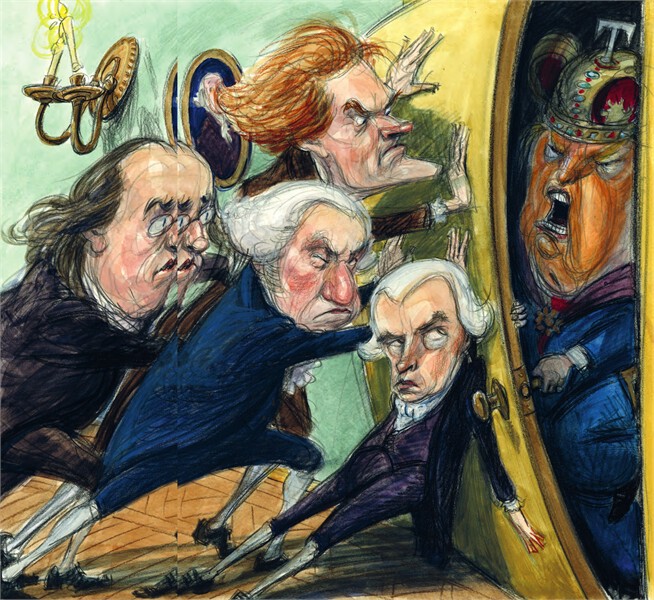
John Avlon’s opinion piece ‘The Founders Warned Us’ for the July/August issue of Rolling Stone magazine got me thinking about the ultra-polarized political environment we find ourselves in today and how often the phrase ‘Founding Fathers’ is tossed around by both sides as either caution of or justification for a myriad of political sins. Even though both sides do use it, the nationalist crowd leans into it particularly hard as a justification for their actions and policies. Returning to the principles of the founding fathers will Make America Great Again, so they say.
This is why Avlon’s piece hit so hard. It crystallizes the fact that one side of our political divide believes they are returning us to the original intent of the founding fathers while the other side believes the Make America Great Again movement (and as the title suggests, its leader) is in fact the very thing the founders tried to protect us from.
“That’s why the founders explicitly warned about the dangers of a demagogue, the poison of hyperpartisanship, the corrosive effects of corruption and foreign influence, the politicization of religion, and the erosion of the separation of powers.”
— John Avlon, The Founders Warned Us, Rolling Stone July/August 2026
Avlon backs up his thesis with the actual words of the founders. No matter your political leanings it is thought-provoking, a good sign for an opinion piece.
If you don’t have a subscription to Rolling Stone or Apple News+ then you could always skip straight to the source.
New Signals
New things to watch, read, or listen to.
 This Week On ICE Podcast
I’ve enjoyed ‘This Week On ICE’, a podcast hosted by journalists Kelly Kimball and Matthew Kendrick, since discovering it about a month ago and I think you will too. We’re inundated every day in our news feed with stories about all the bad social media does to our society, but ‘This Week On ICE’ is an example of new media at its best.
People like Kimball and Kendrick are vital in this current environment where traditional media is under duress from all sides, from the FCC to billionaire owners. Supporting them and those like them is a way to keep the true ideal of journalism for the public good alive.
Signing Off
It’s been a bumpy ride getting Clear Reception off the ground and even though it hasn’t gone exactly as planned, finally releasing it into the world is exhilarating, and a little scary; feelings anyone who has ever created something will understand.
There are still a few rough edges in need of refining over the coming weeks and months, but with the framework in place the cadence of content will steadily increase. This newsletter, Longwave, will arrive in your inbox every week but on the Clear Reception website you can find short-form articles called Shortwaves. These are stand-alone commentary pieces that surface the stories and media you should be aware of.
Clear Reception also has video content on YouTube, TikTok, and Instagram. You can find the audio version of the podcast wherever you get your audio podcasts. Clear Reception is on most of the Social Internet Things as well.
Thank you for reading, and until next week, stay tuned in.
Fritz Martin
Footnotes
- From vote.org: “Utah recently completed one of the most comprehensive citizenship reviews ever conducted at the state level, examining more than 2 million registered voters. They found one confirmed instance of noncitizen registration and zero instances of noncitizen voting. Federal data from U.S. Citizenship and Immigration Services shows that just 0.04% of voter verification cases flag as potential noncitizens, and even within that small group, many had already provided proof of citizenship when they registered.”
-
The SAVE Act’s exact language for documentary proof of United States citizenship, in full:
(b) Documentary proof of United States citizenship.—As used in this Act, the term ‘documentary proof of United States citizenship’ means, with respect to an applicant for voter registration, any of the following:- A form of identification issued consistent with the requirements of the REAL ID Act of 2005 that indicates the applicant is a citizen of the United States.
- A valid United States passport.
- The applicant’s official United States military identification card, together with a United States military record of service showing that the applicant’s place of birth was in the United States.
- A valid government-issued photo identification card issued by a Federal, State or Tribal government showing that the applicant’s place of birth was in the United States.
-
A valid government-issued photo identification card issued by a Federal, State or Tribal government other than an identification described in paragraphs (1) through (4), but only if presented together with one or more of the following:
- A certified birth certificate issued by a State, a unit of local government in a State, or a Tribal government which — was issued by the State, unit of local government, or Tribal government in which the applicant was born; was filed with the office responsible for keeping vital records in the State; includes the full name, date of birth, and place of birth of the applicant; lists the full names of one or both of the parents of the applicant; has the signature of an individual who is authorized to sign birth certificates on behalf of the State, unit of local government, or Tribal government in which the applicant was born; includes the date that the certificate was filed with the office responsible for keeping vital records in the State; and has the seal of the State, unit of local government, or Tribal government that issued the birth certificate.
- An extract from a United States hospital Record of Birth created at the time of the applicant’s birth which indicates that the applicant’s place of birth was in the United States.
- A final adoption decree showing the applicant’s name and that the applicant’s place of birth was in the United States.
- A Consular Report of Birth Abroad of a citizen of the United States or a certification of the applicant’s Report of Birth of a United States citizen issued by the Secretary of State.
- A Naturalization Certificate or Certificate of Citizenship issued by the Secretary of Homeland Security or any other document or method of proof of United States citizenship issued by the Federal government pursuant to the Immigration and Nationality Act.
- An American Indian Card issued by the Department of Homeland Security with the classification ‘KIC’.
— SAVE America Act §2, amending 52 U.S.C. § 20502(b). Read the full text as passed by the House, February 11, 2026 (PDF).